Vincere.dev Vincere
AI / Developer Tools Production System

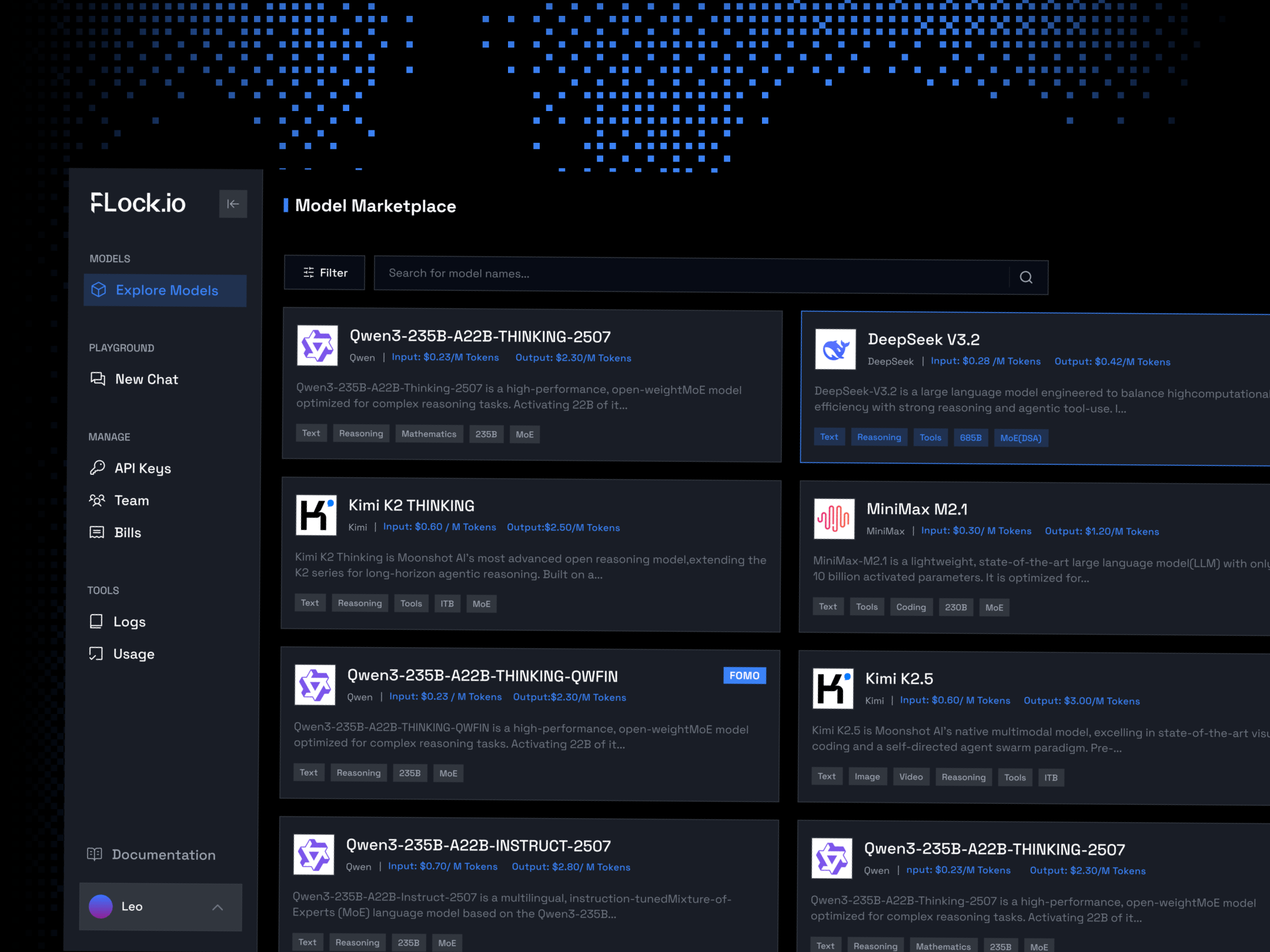
FLock AI Platform

Multi-Provider AI Gateway

FLock AI Platform
5+
LLM Providers
~99%
Uptime
100K+
Daily Logs
Serverless
Deployment

Executive Summary

We built an AI gateway management platform for multiple LLM providers. Its gateway-platform split uses webhook-first synchronization, selective caching, and a PostgreSQL queue. The system supports global enterprise users on minimal infrastructure with about 99% uptime.

The Problem

FLock needed reliable synchronization between LiteLLM and its platform. It had to track micro-usage balances precisely, process hundreds of thousands of daily usage logs, avoid slowing the gateway, and run fault-tolerant internal communication on serverless infrastructure without a native queue.

5+
LLM Providers
100K+
Daily Logs
Global
Enterprise Users
Services Delivered
AI Integration Dedicated Team

Multi-Provider AI Gateway

Architecture Overview

Data Layer
LiteLLM PostgreSQL Supabase
Backend & Orchestration
Next.js Custom Queue
Frontend
Next.js shadcn
Infrastructure
Vercel Supabase

Key Technical Decisions

System Design

LiteLLM is the API gateway for model requests. A Next.js platform manages users, balances, API keys, and orchestration. API calls cover real-time interactions. Webhooks report usage asynchronously. Caching covers frequent gateway data. A daily settlement job repairs missed webhooks, and a parallel pipeline reconciles large log volumes. Supabase PostgreSQL stores data and runs a custom background queue on Vercel.

Key Decisions

Vercel and Supabase minimized deployment overhead while supporting high availability. Caching reduces LiteLLM load by trading a little freshness. Webhook-first sync uses a settlement job to recover from webhook failures. Queue processing protects the database and controls parallelism. The PostgreSQL queue required custom serverless work.

Implementation Highlights

Gateway-state caching reduces repeated LiteLLM calls under load. Hot usage-log and balance paths are indexed and tuned. A PostgreSQL queue processes settlement batches in parallel. The chat playground streams responses for low-latency model tests. Daily settlement reconciles failed webhooks and keeps usage data consistent.

Results & Validation

Supported global enterprise users on Vercel, Supabase, and LiteLLM.

Achieved about 99% uptime.

Maintained performance under heavy API usage through caching and indexing.

Protected data accuracy with reconciliation and settlement jobs.

Key Insights

High-throughput system design for financially sensitive usage data.

Deliberate eventual-consistency handling in distributed systems.

Serverless infrastructure under non-trivial workloads.

Queue and parallel processing without dedicated queue infrastructure.

Webhooks need reconciliation. Selective cache boundaries work better than blanket caching. PostgreSQL can provide a lightweight queue when infrastructure is constrained.

Who This Applies To

Applicable to AI platforms with multiple model providers and usage-based billing. It also fits developer platforms needing gateway abstraction without vendor lock-in on lean infrastructure.

AI Gateway Multi-Provider LLM Usage-Based Billing Serverless Architecture Eventual Consistency

Technologies Used

Backend

Next.js shadcn

Frontend

Vercel

Infrastructure

Supabase PostgreSQL LiteLLM

Data & Integrations

Custom Queue Webhooks Caching Layer

Patterns & Techniques

Streaming Settlement Jobs Parallel Processing GitHub

Building something similar?

We specialize in ai integration and dedicated team for ai / developer tools companies. If you're facing challenges like the ones we solved for FLock AI Platform, let's talk.

30 minutes · No commitment · We respond within 24h